







I Can't Move an Inch - Why Won't My Baby Let Me Put Them Down?
4 min read От Мама За Мами

ON THE CHILD'S "NO!" AND THE ROAD TO INDEPENDENCE
"I can't even get to the bathroom..."
"I put him down for a minute and he starts crying..."
"We carry him all day long, or he won't stop grizzling."
If any of this sounds familiar, know that you're not alone. Many parents (especially with a first child) go through this stage of constant need for closeness, which often brings on doubts:
"Is this normal?"
"Am I spoiling him?"
"Will he always be like this?"
The truth is that the answer isn't about habits or spoiling, it lies in the very nature of a newborn baby: in their need to be close to you, to sense you, to feel constantly connected. Not because something is wrong, but precisely because everything is going exactly as it should.
What happens to a baby in the first few months?
In the first three months after birth (often called the "fourth trimester"), a baby is still developing at the pace and with the needs it had in the womb. It doesn't yet understand that it's outside of you. It doesn't perceive the world as a safe place where it can exist on its own.
A baby has no sense of time. It has no concept of "mum's just popping out and will be back". It experiences separation as a loss of safety, a loss of protection, a loss of life itself.
Its nervous system is still immature. It doesn't yet know how to calm itself, because the mechanisms for self-regulation simply aren't in place yet. That means that when it cries and you're not there, it isn't being fussy, it's sending a signal: "I need my mum to survive."
And what do its instincts say?
A baby has an incredibly well-developed instinct for closeness. It seeks out touch, voice, heartbeat and the scent of its mother, because these remind it of the womb. When it's in your arms, the level of stress hormones in its body drops. Breathing and heart rate settle. It relaxes.
Yes, a baby feels best in your arms, close to your heart. And the more of this closeness you give in the beginning, the more secure and independent it will become later on.
What this behaviour does NOT mean
It doesn't mean you're "spoiling" them.
It doesn't mean they'll be "glued to you" forever.
It doesn't mean you're doing anything wrong.
It means you're responding to a natural biological need, one that will gradually give way to independence over time. But only if your child has been sure that whenever they needed you, you were there.
So what can you do?
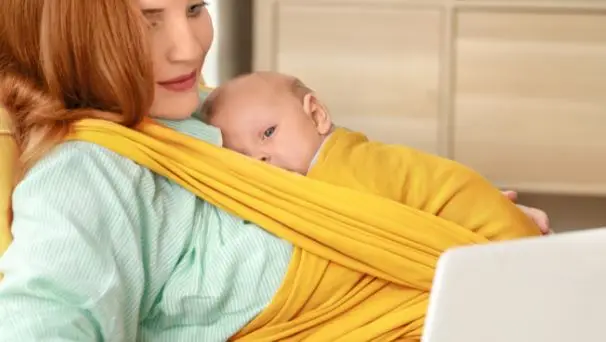
Use a sling or an ergonomic carrier, so your hands stay free while you keep your baby close.
Talk to your baby as you move around the room, so they can hear your voice and feel calmer.
Give yourself permission to sit down, cuddle up with them, and do "nothing else". Sometimes that's the most important thing of all.
Don't compare yourself to others. Every baby is different: some have a stronger need for closeness, others less so. And all of that is completely normal.
And what does a baby gain from all this closeness?
Much more than it might seem at first glance.
You're not just holding them. You're building the foundation of trust.
When you respond to their need for you, your baby learns:
"The world is safe."
"I matter."
"I can trust."
This sense of security will be their inner compass for years to come.
And little by little, you'll start to see them venture further away, more boldly each time.
But for now, they just want to be close to you.
If you're feeling exhausted, that's normal too. Your baby's constant need for you is beautiful, but it's also a lot to carry.
Ask for help, rest, and lean on your partner or loved ones.
Taking care of yourself is part of taking care of your baby.
You are their whole world.
And no, you're not spoiling them.
You love them.
And that's enough.
See how you can support your child's development and bring more harmony to your family by joining the community of all Super Parents, because being a confident parent is a set of skills, and shared experience is the most valuable thing of all: https://superroditeli.com/